
Table of Contents
- What Makes Educational Toys Effective for Focus
- Sensory Toys for Concentration: Understanding the Connection
- Best Focus Toys for Kids: Key Selection Criteria
- How to Encourage Deep Play and Sustained Attention
- Managing Toy Quantity and Overstimulation
- Fine Motor Skills and Hand-Eye Coordination Development
- Building Problem-Solving and Executive Function
- Practical Steps to Start Selecting Toys for Better Focus
- Frequently Asked Questions
Last Updated: October 2, 2026
What Makes Educational Toys Effective for Focus
Educational toys for focus work by engaging multiple senses and brain systems at once. They demand attention without overwhelming the child.
When a toy matches a child's skill level, they enter "deep play", a state where concentration deepens naturally.
The key is matching toy complexity to the child's developmental stage.
CleanCharge's curated collection focuses on toys that encourage problem-solving and hands-on engagement rather than passive entertainment.
Sensory Toys for Concentration: Understanding the Connection
Toys that engage multiple senses help children regulate their nervous system and sustain attention longer.
Tactile feedback activates focus naturally. When hands manipulate objects with satisfying resistance or texture, the brain locks in, creating a calming loop.
Open-ended sensory play builds executive function, the mental system managing attention, planning, and impulse control. Sequencing toys (stacking, sorting, building) strengthen these skills directly.
The metal fidget spinner from CleanCharge delivers consistent tactile feedback with smooth, extended spin times. For kids who need movement to focus, this type of sensory tool creates the grounding they need to sit through homework or reading time.
Best Focus Toys for Kids: Key Selection Criteria
Choosing the right toy requires understanding your child's focus style. Some need movement, others need to build or solve, and some have neurological differences that change what focus looks like.
Age-Appropriate Complexity
Age determines what the child's brain can process. Too-simple toys bore; too-complex toys frustrate.
Look for toys with adjustable difficulty. The Particle Building Blocks Educational Toy comes in multiple piece counts (280 to 1000 pieces), allowing the toy to grow with the child.
Check the manufacturer's age range, but trust your knowledge of your child. Some 4-year-olds handle 5+ complexity. Others need to stay at their age level.
Open-Ended Play vs. Structured Activities
Open-ended toys (blocks, building systems) let children decide what to make and develop creativity. Structured toys (chess, puzzles, strategy games) follow defined rules and build planning. Ideally, a collection includes both.
The Educational Tic-Tac-Toe Three-Character Chess Rice Chess Children's Toys combines both. It has structure (game rules) but allows strategic creativity (multiple ways to win). This hybrid approach keeps engagement high.

Neurodivergent-Specific Selection: ADHD and Sensory Processing Differences
Children with ADHD or sensory processing differences often have different focus needs than neurotypical peers. Standard toy recommendations may not work for them.
For ADHD:
- High-feedback toys work better: Toys with satisfying tactile resistance, auditory feedback, or visual feedback help regulate dopamine and sustain focus.
- Movement-integrated toys are necessary: Many children with ADHD cannot sit still while focusing. Toys allowing movement while engaging the mind work better than seated-only options.
- Avoid too many rules initially: Start with single-rule games (Tic-Tac-Toe) rather than multi-rule games (Chess).
- Novelty matters more: Children with ADHD habituate faster. A 2-week rotation cycle works better than monthly.
For Sensory Processing Differences:
Children with sensory processing differences may be hypersensitive (overwhelmed by input) or hyposensitive (seeking intense input). Toy selection depends on which profile fits.
- Hypersensitive children need controlled, predictable input: Choose toys with gentle tactile feedback, quiet operation, and muted colors. Avoid loud sounds and bright flashing lights.
- Hyposensitive children need intense, satisfying input: Heavy building blocks, resistance-based fidgets, and weighted toys work better.
- Proprioceptive input aids focus: Toys providing pressure or resistance help regulate the nervous system.
Identifying Your Child's Profile:
Observe whether your child seeks or avoids movement, prefers strong or gentle sensory feedback, and habituates to toys quickly or slowly.
How to Encourage Deep Play and Sustained Attention
Deep play is a neurological state called 'flow,' where the prefrontal cortex quiets and task-focus areas activate intensely.
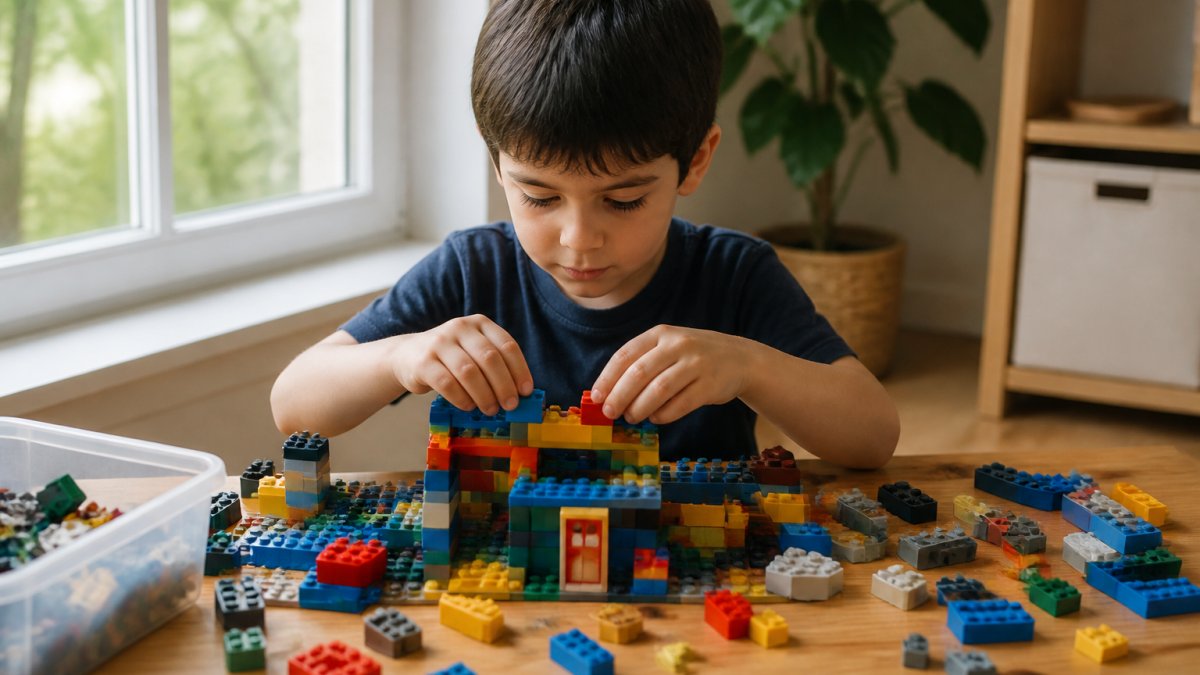
1. Challenge-Skill Balance: The toy's difficulty must sit just above the child's current ability.
2. Clear, Immediate Feedback: The toy must confirm success in real time.
3. Intrinsic Motivation (Child-Directed Choice): When a child chooses the activity, the brain's motivation centers activate differently.
Educational Tictactoe Three-character Chess Rice Chess Children's Toys →
The Toy Rotation Method: Environmental Design for Focus
The play environment itself is critical.
The toy rotation method works like this:
- Keep 5-7 toys accessible at any time. This is the number most child development specialists recommend as the threshold before decision paralysis sets in. For a 5-year-old, this might mean 5 toys; for a 7-year-old, 7 toys.
- Store the rest in labeled, opaque bins. Out of sight means out of cognitive load. The child's brain doesn't have to process toys they can't see.
- Rotate toys monthly. When a toy returns after 4 weeks away, it feels novel again. This resets engagement and prevents habituation, the brain's tendency to tune out familiar stimuli. A toy that lost the child's interest in week two often recaptures it in week six.
- Observe which toys get played with most during the rotation. These are the ones that match the child's current developmental stage and interests. Keep these in the active set longer; rotate others out sooner.
Managing Toy Quantity and Overstimulation
Too many toys create decision paralysis and anxiety. Children in cluttered environments have shorter attention spans and higher stress. The solution is curation.
Start with one toy per year of age (5-year-old gets 5 toys). Organize by category: building, problem-solving, fine motor, sensory, and creative. Rotate monthly and store out-of-sight toys in labeled bins.
Fine Motor Skills and Hand-Eye Coordination Development
Fine motor skills and hand-eye coordination are essential for focus. Manipulating small objects strengthens neural pathways supporting sustained attention.
The 14 Pcs Children DIY Human Organ Model Educational Toy builds fine motor skills through assembly, teaching anatomy while demanding focus and problem-solving. Hand-eye coordination improves through repetition, freeing mental energy for deeper focus.

Building Problem-Solving and Executive Function
Executive function is the mental control center. It manages planning, working memory, and impulse control.
Toys that build executive function require the child to:
- Plan multiple steps ahead
- Remember rules or sequences
- Adjust strategy based on outcomes
- Persist through difficulty
Strategy games and construction challenges do this naturally.
The Educational Tic-Tac-Toe Three-Character Chess Rice Chess toy builds executive function directly. Kids must plan moves, anticipate opponent responses, and adapt strategy.
Logical reasoning develops through pattern recognition. Toys with repeating patterns or rule-based systems train the brain to spot patterns and predict outcomes.
Practical Steps to Start Selecting Toys for Better Focus
Follow this process to build a focus-supporting toy collection:
| Step | Action | Timeline |
|---|---|---|
| 1. Assess current focus | Observe which activities hold attention longest | This week |
| 2. Identify learning style | Notice if child prefers building, solving, creating, or moving | This week |
| 3. Set toy budget | Decide on quantity (one per age year is a good start) | Before shopping |
| 4. Choose categories | Pick toys across building, problem-solving, and fine motor | Before shopping |
| 5. Test one toy | Buy one toy that matches the child's interests and age | This week |
| 6. Observe engagement | Track how long the child plays without prompting | 2 weeks |
| 7. Rotate and refine | Add toys that showed promise; rotate monthly | Ongoing |
Start with one toy that matches your child's demonstrated interests. Don't buy a collection at once. Observe what works. Build from there.
CleanCharge offers a range of educational toys selected specifically for focus and engagement. The Particle Building Blocks, the DIY Human Organ Model, and the Educational Tic-Tac-Toe Chess toy each address different learning styles and age ranges. Start with whichever matches your child's current fascination. Use code First20 for 20% off your first purchase at https://shopcleancharge.com.

Choosing educational toys for focus isn't about buying the most expensive or most complex option. It's about understanding your child's learning style and matching toys that build sustained attention through engagement. The right toy becomes a tool for developing executive function, fine motor skills, and problem-solving, skills that transfer to every area of learning.
American Psychological Association guidance on child development and play
Society for Research in Child Development research on executive function
Frequently Asked Questions
What types of toys help improve a child's focus?
Toys that promote hands-on engagement, problem-solving, and sustained attention work best. Building blocks, strategy games like chess, and manipulatives that require fine motor control help children develop concentration. Open-ended toys that don't have a single 'correct' outcome encourage deeper engagement. Educational toys with sensory elements, like tactile feedback or varied textures, support attention span development by providing grounding and stimulus control.
How do sensory toys for concentration actually work?
Sensory toys provide tactile feedback and engagement that helps children regulate their cognitive load and maintain focus. Fidget tools with smooth rotation or textured surfaces offer grounding techniques that calm overstimulation while keeping the mind engaged. Metal fidget spinners, for example, deliver extended spin times and smooth rotation that can help sustain attention without overwhelming the senses, making them effective for classroom or homework settings.
Are fidget toys effective for classroom focus?
Yes, when chosen carefully. Fidget tools that provide quiet, smooth motion without excessive noise support concentration during learning. A metal fidget spinner with a high-grade bearing delivers up to 3 minutes of smooth rotation, giving children a physical outlet that reduces restlessness without distracting peers. The key is selecting fidgets that offer sensory input without creating overstimulation or classroom disruption.
How long should a child play with an educational toy to build focus?
Start with 15-20 minutes of uninterrupted play and gradually extend as your child's attention span grows. Deep play requires time for the child to move past initial exploration into problem-solving and creative thinking. Rotating toys every few weeks prevents habituation and maintains engagement. Consistent, focused play sessions build executive function and sustained attention better than scattered, brief interactions with many toys at once.