
Table of Contents
- How UV-C Light Kills Germs on Your Phone
- UV Sanitizer vs Alcohol Wipes: Which Actually Works?
- How Long to Sanitize Your Phone With UV Light
- How to Clean Your Phone Screen Safely
- Why UV Sanitizers Miss Germs: Shadowing and Line-of-Sight Limits
- What UV Light Does to Your Phone Over Time
- Maintenance and Bulb Lifespan: The Part Nobody Mentions
- Frequently Asked Questions
Last Updated: September 14, 2026
How UV-C Light Kills Germs on Your Phone
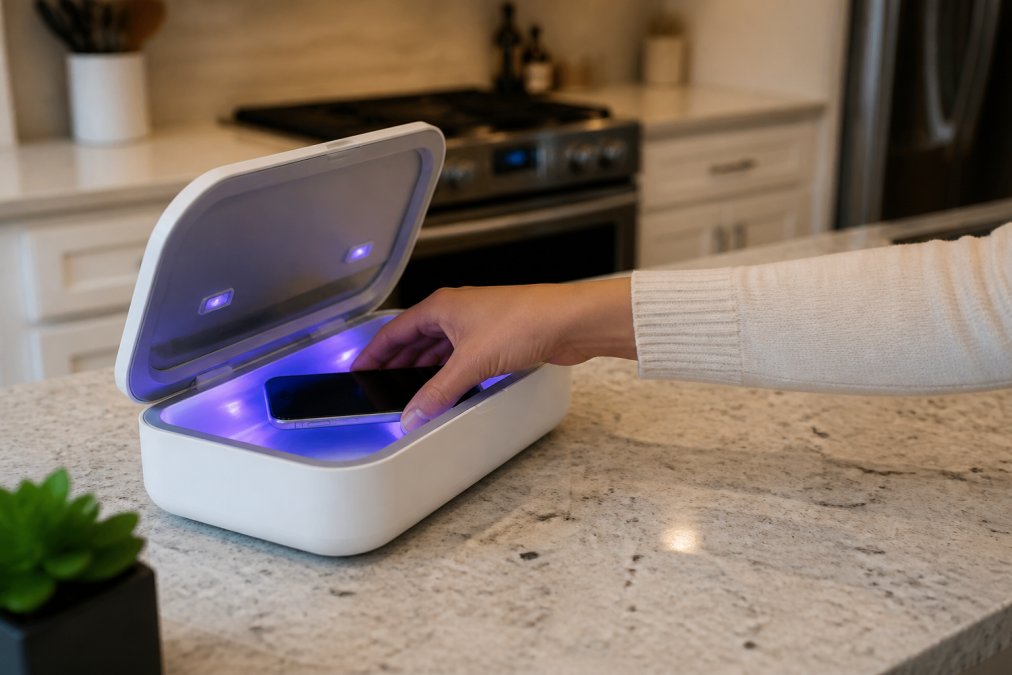
If you've ever wondered do uv sanitizers actually kill phone germs, the short answer is yes, but only under conditions most home devices don't fully meet. UV-C light in the germicidal wavelength range disrupts the DNA and RNA of microorganisms, preventing them from reproducing. This guide from CleanCharge breaks down what the science supports, where real-world use falls short, and how to sanitize your phone without damaging it.
The Germicidal Wavelength and DNA Disruption
UV-C sanitization is the process of using ultraviolet light in the 200-280 nanometer range to damage the genetic material of bacteria, viruses, and fungi. At roughly 254 nanometers, photons are absorbed by nucleic acids, forming pyrimidine dimers that break the microbe's ability to replicate.
That's cellular breakdown at the molecular level. A pathogen that can't reproduce can't infect you. The catch is that this only happens when enough UV-C energy reaches the microbe for long enough. Intensity, exposure time, and distance all determine whether you get meaningful pathogen neutralization or just a light bath.
Most consumer devices advertise "germicidal" properties without publishing log reduction data. A 1-log reduction kills 90% of a given microbe. A 3-log reduction kills 99.9%. Those are very different outcomes, and the difference usually comes down to how the device is built, not the wavelength it claims to emit.
UV Sanitizer vs Alcohol Wipes: Which Actually Works?
Alcohol wipes and UV-C sanitizers kill germs through completely different mechanisms, and that difference determines which surfaces each one actually cleans. Understanding the mechanism is the only way to judge the marketing claims on either product.
How alcohol kills: A 70% isopropyl alcohol solution denatures proteins and disrupts lipid membranes. The 30% water content matters, water slows evaporation and helps the alcohol penetrate the cell wall, which is why 70% outperforms 91% on many pathogens. Alcohol is also a solvent: it lifts oils, sebum, and the grime that harbors microbial load, so it removes germs rather than just inactivating them. The CDC guidance on cleaning and disinfecting surfaces notes that disinfection only works when the surface stays visibly wet for the product's stated contact time, typically 30 seconds to several minutes for alcohol-based products.
How UV-C kills: UV-C photons at roughly 254 nanometers are absorbed by nucleic acids, forming pyrimidine dimers that block replication. UV-C does not remove grime, oil, or dust. In fact, a film of oil or dust shields microbes underneath it from the dose, a phenomenon called shielding. That means a dirty phone screen can defeat a UV cycle that would work fine on a clean one.
Here is the honest split on where each method wins:
- Alcohol wins on reachable flat surfaces, screens, back glass, and case exteriors. It removes oil and grime, and it kills on contact without needing line-of-sight.
- UV-C wins on surfaces you cannot safely wet, speaker grilles, charging ports, camera cutouts, and the seams around buttons. Liquid in those openings causes corrosion and can void warranties.
- Alcohol wins on speed, a wipe-down takes seconds. A UV cycle takes 5-10 minutes and only treats what the light reaches.
- UV-C wins on material compatibility for the screen coating, repeated solvent exposure strips the oleophobic layer faster than UV-C alone does.
What neither method does well: clean a phone inside a thick case. A case blocks UV the same way it blocks light, and alcohol cannot reach the crevices between the case and the phone body. Remove the case before either method.
How Long to Sanitize Your Phone With UV Light
Most consumer UV phone sanitizers run a 5-10 minute cycle. That's the manufacturer's claim, not a lab-verified dose. Actual sanitization efficacy depends on intensity at the surface and whether the phone is positioned to expose both sides.
A reasonable rule: run the full cycle the device specifies, and don't cut it short to save time. Exposure time is one of the two variables that determines whether UV-C does anything at all. The other is intensity, which drops sharply with distance from the bulb.
If your sanitizer has a single bulb on one side, flip the phone halfway through. If it has bulbs top and bottom, a single cycle covers both faces. Keep the phone out of its case during the cycle. Cases block UV the same way they block light.
How to Clean Your Phone Screen Safely
Cleaning a phone screen safely means matching the method to the surface. The glass has an oleophobic coating that repels oil and makes fingerprints easier to wipe. Alcohol and abrasive cloths strip that coating over time, leaving the screen smudgier than before.
Here's a routine that protects the screen and reduces surface contamination:
- Power the phone off and unplug any cables.
- Use a dry microfiber cloth to remove loose dust and grit first.
- If using a wipe, choose a 70% isopropyl alcohol wipe and avoid dripping liquid into openings.
- Wipe gently in one direction; don't scrub.
- Let the surface air-dry completely before powering back on.
- Run a UV cycle afterward if you want coverage in ports and grilles.
The Apple support guidance on cleaning iPhone recommends avoiding bleach, abrasives, and aerosol sprays, and keeping liquids out of openings. That advice applies to any modern smartphone, not just one brand.
Why UV Sanitizers Miss Germs: Shadowing and Line-of-Sight Limits
Shadowing is the single biggest reason UV sanitizers underperform in real use, and it is also the reason lab results rarely translate to a phone sitting in a consumer device. UV-C travels in straight lines and obeys an inverse-square relationship with distance: doubling the distance from the bulb to the surface cuts the intensity to roughly one-quarter. A phone lying flat in a tray with a single bulb overhead gets a strong dose on the top face and almost nothing on the sides, the bottom, or the recessed areas around the camera module.
Where the shadows actually are on a phone:
- The charging port and speaker grilles, recessed openings where light cannot reach past the lip
- The camera bump and lens rings, raised geometry that casts shadows on the surrounding back panel
- Button seams and the gap between the screen and the frame
- The underside of the phone if the device has bulbs on only one side
- Anywhere a case, skin, or pop-socket covers the surface
This is why a lab result on a flat stainless steel coupon, the standard test surface, tells you almost nothing about real-world performance. A flat coupon has no shadowed geometry. A phone is nothing but shadowed geometry.
What 'lab-tested' actually means. Most consumer UV sanitizers cite a log reduction figure, but the number is meaningless without the test conditions. A 3-log reduction (99.9%) on a flat coupon at a fixed distance from a specific bulb does not mean 3-log reduction on your phone in the chamber. Ask three questions of any claim: What surface was tested? What distance from the bulb? What pathogen? A device that publishes all three is rare, and the ones that do are usually the ones worth buying.
What device design actually mitigates shadowing:
- Reflective interior walls. A mirrored or polished stainless chamber bounces UV-C into some shadowed areas. A matte plastic interior absorbs it. This is the single biggest design difference between devices that work and devices that just glow.
- Multiple bulbs on opposing sides. Top-and-bottom bulb placement treats both faces in one cycle. A single-bulb device requires you to flip the phone halfway through.
- Vertical or angled phone positioning. Propping the phone so light hits the edges reduces the flat-surface shadowing that a lying-flat position creates.
- A chamber sized close to the phone. Excess air volume means more distance between bulb and surface, which means lower intensity at the phone.
The FDA information on UV-C disinfection devices notes that UV-C effectiveness depends on direct exposure and that shadowed areas may not be adequately treated, a point most product listings omit.
What UV Light Does to Your Phone Over Time
UV-C doesn't just hit germs. It hits plastics, adhesives, and coatings too. Prolonged ultraviolet radiation exposure is well known to degrade polymers, causing yellowing, brittleness, and adhesive failure. The question is whether a 5-minute daily cycle is enough to matter.
For most phones, occasional UV cycles cause no visible damage. The concern grows with frequency and intensity. Hospital-grade UV-C equipment, which runs at far higher doses, is not something you'd want to use on a personal device daily. Consumer units operate at much lower intensity, which limits both germ-killing power and material stress.
Watch for these over time if you sanitize daily:
- Slight yellowing on clear plastic cases
- Adhesive softening around screen edges
- Fading on printed or dyed surfaces
The oleophobic coating on your screen is the most vulnerable layer. UV-C alone is gentler on it than alcohol, but combined daily use of both accelerates wear.
Maintenance and Bulb Lifespan: The Part Nobody Mentions
UV-C bulbs lose germicidal output long before they stop glowing. A bulb that still emits visible light may have dropped below the intensity needed to achieve meaningful log reduction. Most manufacturers rate their bulbs for a set number of hours, and output declines steadily across that lifespan.
Replace bulbs on the schedule the device specifies, not when they visibly fail. If your sanitizer has no hour counter, track cycles manually. A device that ran strong for two years may now be doing very little.
Clean the interior chamber too. Dust and residue on reflective walls reduce how much UV-C reaches the phone, which quietly shrinks your coverage.
UV sanitizers do kill phone germs, but only when they deliver enough intensity, for long enough, with the phone positioned so light actually reaches the surface. Shadowing, bulb aging, and geometry quietly undercut that in most home setups. Combine a UV cycle with a proper wipe-down, and you cover both the surfaces you can see and the crevices you can't.
CleanCharge carries a range of lifestyle gadgets designed to make daily routines simpler, including sanitization tools that fit into a normal cleaning habit. Browse the collection, and take 20% off your first order with code First20 at CleanCharge shop.
Frequently Asked Questions
Do UV sanitizers really work for phones?
UV-C sanitizers can kill many germs on phone surfaces, but results depend on exposure time, intensity, and whether light reaches the entire surface. Lab testing shows high log reduction rates against bacteria and viruses on exposed areas. In practice, shadowing from phone cases, camera bumps, and ports means some spots get missed. Think of UV sanitizers as one layer of protection, not a complete solution.
Is there a downside to using UV sterilizers on electronics?
UV-C is non-ionizing radiation, so it will not cause the kind of damage X-rays do. However, repeated exposure can degrade oleophobic coatings on phone screens over time, making them more prone to fingerprints and smudges. Rubber gaskets and some plastics may also fade or become brittle with prolonged use. Most devices are designed to handle years of regular cycles, but it is worth knowing the tradeoff.
What is the best thing to disinfect your phone with?
The most effective approach combines methods. Wipe the screen and case with a 70% isopropyl alcohol wipe to remove oils and surface contamination, then use a UV sanitizer for areas wipes cannot reach, like speaker grilles and charging ports. For a UV sanitizer vs alcohol wipes comparison, alcohol handles visible grime and bioburden while UV adds a chemical-free pass on exposed surfaces. Neither alone covers everything.
Can UV light damage my phone screen or internal components?
UV-C light does not penetrate glass or metal, so internal components are not at risk. The main concern is surface-level: oleophobic coatings on screens can wear down faster with frequent UV exposure. If you sanitize daily, expect the coating to lose some effectiveness within a year. Using a screen protector you can replace is a practical way to protect the original coating.