
Table of Contents
- Why Creative Stationery Changes How You Work at Home
- Aesthetic Desk Accessories for Productivity That Earn Their Space
- Creative Ways to Store Office Stationery in Small Spaces
- Must-Have Office Supplies for Remote Workers in 2026
- Ergonomic Stationery Integration: Where Comfort Meets Creative Work
- Sustainable and Eco-Friendly Stationery That Lasts
- Stationery for Neurodivergent Workflows: Focus Tools That Actually Help
- Conclusion
- Frequently Asked Questions
Last Updated: September 23, 2026
Why Creative Stationery Changes How You Work at Home
The right creative stationery for home office setup does more than look good on a shelf. It changes what you reach for, how quickly you capture an idea, and whether your desk feels like a place you want to sit down at.
This guide from CleanCharge breaks down what actually earns space on a home desk in 2026: the accessories that pull their weight, the storage tricks that survive small rooms, and the tools that help specific brains focus. The U.S. General Services Administration workplace guidance makes a simple point that applies to home offices too: how a workspace is arranged affects how well people work in it.
Most stationery advice stops at "buy pretty things." That's the part worth fixing.
Aesthetic Desk Accessories for Productivity That Earn Their Space
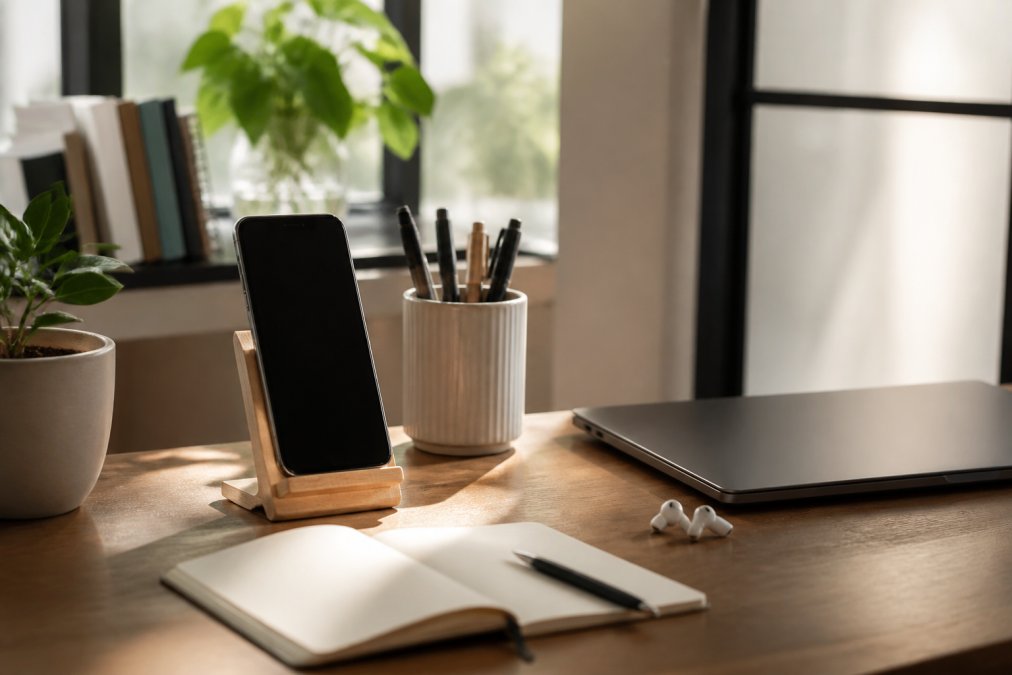
Aesthetic desk accessories for productivity earn their place by doing a job, not by matching a color palette. A phone stand, a pen cup, a desk pad, and a pair of earbuds cover most of what a home desk actually needs.
The 80/20 Rule for Desk Accessories
Four items do most of the work: something to hold your phone, something to hold your pens, something to write on, and something to cut noise. Everything else is optional.
- Phone or device stand for calls and reference material
- Pen cup or tray so writing instruments have one home
- Desk pad to define the work zone and protect the surface
- Earbuds for calls and focus blocks
Tech That Belongs on the Desk, Not in a Drawer
Tech earns counter space when you use it daily. The Colorful Sound Wireless Bluetooth Earbuds with Noise Canceling ($19.99) run up to 8 hours on a charge with Bluetooth 5.3 and an IPX4 waterproof rating, which covers a full workday of calls and playlists. For lighter use, the D012 TWS Wireless Bluetooth Earbuds ($14.99) pair automatically when you lift them from the case.
Creative Ways to Store Office Stationery in Small Spaces
Creative ways to store office stationery start with going up, not out. The goal is to move supplies off the work surface and into vertical or layered space so the desk stays clear for actual work. A typical small home office has roughly 2 to 3 square feet of usable desktop, so every object that leaves the surface is a real gain.
Vertical Storage That Doesn't Look Like a Filing Cabinet
Use the wall. A slim floating shelf mounted 18 to 24 inches above the desk holds pen cups, sticky notes, and a small stack of paper goods within arm's reach. A pegboard does the same job with more flexibility because hooks can be repositioned as your tools change, and it reads as intentional design rather than office furniture.
Three vertical options worth comparing:
- Floating shelf: cheapest, holds the most weight, but fixed once mounted
- Pegboard: most flexible, best for tools that change often, needs wall anchors for anything heavy
- Over-the-door or cabinet-hung organizer: no drilling, good for renters, limited to lighter items
Budget-Friendly DIY Stationery Hacks
You do not need to spend much to fix desktop clutter. Most of these take under ten minutes and use items already in the house.
- Cut a cereal box into a tray and wrap it in contact paper for a free drawer organizer
- Use a mason jar as a pen cup and a second one for clips
- Repurpose a shoe box lid as a shallow supply tray
- Clip binder clips to a shelf edge to hang cables
- Turn a magazine file into vertical paper storage
- Rubber-band a small cutting board to a bookend for an instant upright file slot
- Cut a paper towel tube into rings to corral rolled cables and pens
The One-In-One-Out Rule
Small spaces punish accumulation faster than large ones. Every time a new pen, pad, or gadget comes in, something goes out. This keeps the storage system from overflowing and forces you to notice what you actually use. A drawer that stays closed for a month is a drawer you can empty.
Must-Have Office Supplies for Remote Workers in 2026
Must-have office supplies for remote workers come down to three categories: something to write with, something to write on, and something to hold it together. Everything else is preference. What most guides skip is how much of each you actually need and how the pieces fit together into a workflow you will maintain past week two.
Phone Stand with Lazy Ring and →
The Minimum Viable Stationery Kit
A workable starter kit fits in a single shoebox and costs well under what a full collection does:
- Two pens you actually like, one for writing, one as backup. More than two means you stop noticing which one works.
- One notebook, A5 or smaller, so it stays open on the desk instead of getting buried.
- One pad of sticky notes, 3x3 inch is the standard size that fits on a monitor bezel or laptop edge.
- One pack of index cards, for tasks you move around, not tasks you file.
- One desk pad, defines the work zone and gives a smooth writing surface.
- One small tray or cup, a single home for the pens, clips, and cards above.
How the Pieces Fit Together
The writing surface matters more than people expect. A desk pad defines where work happens and gives you a smooth surface for notes and sketches. Pair it with a planner system you will actually open, whether that's a paper agenda, a weekly notepad, or a simple bullet journal. The test is simple: if updating the system takes more than a minute, it will not survive the week.
A Unique Angle: Match the Kit to Your Work Mode
Most guides assume one kind of remote worker. In practice, the right kit depends on how you spend your day:
- Meeting-heavy days: prioritize a phone stand at eye level, a notebook for live notes, and a quiet fidget tool for long calls.
- Deep-focus days: prioritize a clean desk pad, one pen, one notebook, and a way to silence notifications. Fewer objects means fewer interruptions.
- Hybrid or shared-space days: prioritize a tray that lets you pack the whole kit into a drawer or bag in under a minute, so setup and teardown are not a chore.
What to Skip
Skip anything that requires its own maintenance routine. Multi-color pen sets, elaborate planner inserts, and decorative organizers that need rearranging all add steps without adding output. The supplies that survive a year on a real desk are the ones you never have to think about.
Ergonomic Stationery Integration: Where Comfort Meets Creative Work
Ergonomic stationery integration means placing tools where your hands already go, so you stop reaching, twisting, and straining. The goal is a desk layout that supports long sessions without discomfort.
Sustainable and Eco-Friendly Stationery That Lasts
Sustainable and eco-friendly stationery lasts longer and gets replaced less often, which is the real environmental win. Durability beats novelty every time.
Stationery for Neurodivergent Workflows: Focus Tools That Actually Help
Stationery for neurodivergent workflows works when it reduces friction instead of adding steps. Tactile focus tools and simple capture systems help more than elaborate planners that require maintenance.
Conclusion
Building a home office that actually works takes trial and error, and most people quit before they find the four or five items that fit how they think.
Frequently Asked Questions
What are the essential stationery items for a home office?
A solid home office setup starts with a notebook or planner system, two or three quality pens, sticky notes, a desk pad, and a cable management tray. Add a phone stand like CleanCharge's Lazy Ring model ($7.99) to keep your screen visible during calls. The goal is fewer items you actually reach for daily, not a drawer full of supplies you never touch.
How can creative stationery improve productivity in a home office?
Creative stationery reduces friction. When your planner, pens, and sticky notes sit within arm's reach and look good, you are more likely to use them. Aesthetic desk accessories for productivity work the same way: a visible planner invites planning, while a buried one gets ignored. Physical tools also pull you away from phone notifications, which helps you stay in a focused work rhythm.
How do you organize a home office with limited space?
Go vertical. Stack trays, wall-mounted pinboards, and acrylic organizers free up desktop space without adding furniture. Use a bulletin board for active projects and a drawer for archive items. Creative ways to store office stationery include repurposed jars, magnetic strips on a wall panel, and foldable storage boxes that collapse when empty. CleanCharge's Portable Desktop Range Hood ($25.99) even fits on a compact desk if you need to clear smoke or odors in a small workspace.
What are the best desk accessories for a minimalist office setup?
For a minimalist desk, pick items that serve two purposes. A phone stand doubles as a charging dock. A Bluetooth fingertip remote ($39.99 from CleanCharge) works as a phone stand and a hands-free controller. Wireless earbuds like the i80 TWS model ($14.99) keep audio gear off the desk surface. Stick to one accent color and two or three functional pieces; everything else lives in a drawer.