
Table of Contents
- What to Look For in Sanitizing Gadgets for Personal Tech
- Do UV Sanitizers Actually Kill Germs? What the Science Says
- UV-C Light Safety for Electronics: What You Can and Can't Sanitize
- Best Practices for Sanitizing Personal Devices
- Types of Sanitizing Gadgets for Personal Tech Compared
- Common Mistakes That Waste Your Sanitizing Gadget
- Conclusion
- Frequently Asked Questions
Last Updated: September 23, 2026
What to Look For in Sanitizing Gadgets for Personal Tech
The best sanitizing gadgets for personal tech solve one problem: your phone, earbuds, and smartwatch pick up bacteria everywhere you take them. This guide from CleanCharge breaks down what actually matters when you're comparing options, from wavelength specs to build quality.
Most shoppers get distracted by flashy features. The specs that matter are simpler than the marketing suggests.
Key Specs That Actually Matter
UV-C wavelength sits at the top of the list. Devices that emit light in the 265-280 nanometer range are designed to disrupt microbial DNA. Anything outside that band does far less.
Chamber size determines what you can actually fit. A box that holds a phone may not hold a tablet or a pair of over-ear headphones.
Cycle time tells you how long a full session takes. Most units run between 3 and 10 minutes. Shorter isn't always better; coverage matters more than speed.
Build and safety features include auto shut-off when the lid opens, child locks, and interior reflective lining that bounces light into crevices.
| Spec | Why It Matters | What to Look For |
|---|---|---|
| UV-C wavelength | Germ-killing range | 265-280 nm |
| Chamber size | Device compatibility | Fits phone + earbuds |
| Cycle time | Convenience | 3-10 minutes |
| Safety shut-off | Prevents UV exposure | Auto-off on lid open |
| Interior lining | Even coverage | Reflective surfaces |
Do UV Sanitizers Actually Kill Germs? What the Science Says
UV-C light in the germicidal range damages the nucleic acids inside bacteria and viruses, which stops them from reproducing. That mechanism is well established in laboratory settings and is the same principle hospitals use for room disinfection.
The catch is that real-world results depend on dose. Dose equals intensity multiplied by time, and light has to reach the surface directly. A phone case with deep grooves or a keyboard with gaps between keys can shield microbes from the light entirely.
According to the FDA's guidance on UV-C disinfection devices, UV-C products vary widely in effectiveness and consumers should treat claims with care. The EPA's list of registered antimicrobial devices is a useful reference for verifying what a device is actually cleared to do.
Practical takeaway: UV-C sanitizers reduce surface contamination on smooth, exposed surfaces. They are not a substitute for wiping down a visibly dirty screen.
UV-C Light Safety for Electronics: What You Can and Can't Sanitize
UV-C light is safe for most bare electronics because it doesn't penetrate glass, plastic housings, or metal. It works on surfaces only, which is exactly why it's a good fit for phones, earbuds, and remotes.
What you should keep out of a UV-C chamber:
- Devices with adhesive screen protectors that are already peeling
- Anything with exposed rubber gaskets that may dry out over repeated cycles
- Items with printed labels or heat-sensitive inks
- Cameras and lenses with delicate anti-reflective coatings
Screens, Coatings, and Case Materials
Oleophobic coatings on modern phone screens are designed to resist oils, not UV light, so typical exposure levels in a consumer sanitizer won't strip them. The bigger risk is abrasion from wiping, not light.
Leather cases, fabric folios, and anything with glued seams are the items most likely to show wear over time. Silicone and hard plastic cases hold up best.
Best Practices for Sanitizing Personal Devices
Consistency beats intensity. A short daily cycle on your phone does more than a long weekly one, because bacteria repopulate quickly after handling.
A simple routine that works:
- Remove the case and any attachments before each cycle
- Wipe off visible smudges with a dry microfiber cloth first
- Place items with space between them so light reaches all sides
- Run a full cycle, not a shortened one
- Wipe down the interior of the sanitizer weekly
For best practices for sanitizing personal devices, remember that UV-C is one layer. Pair it with regular handwashing and avoid sharing earbuds. The CDC's guidance on cleaning and disinfecting reinforces that surface hygiene works best as part of a broader routine.
Types of Sanitizing Gadgets for Personal Tech Compared
Three form factors dominate the market: UV-C boxes, UV wands, and spray-based tools. Each fits a different use case.
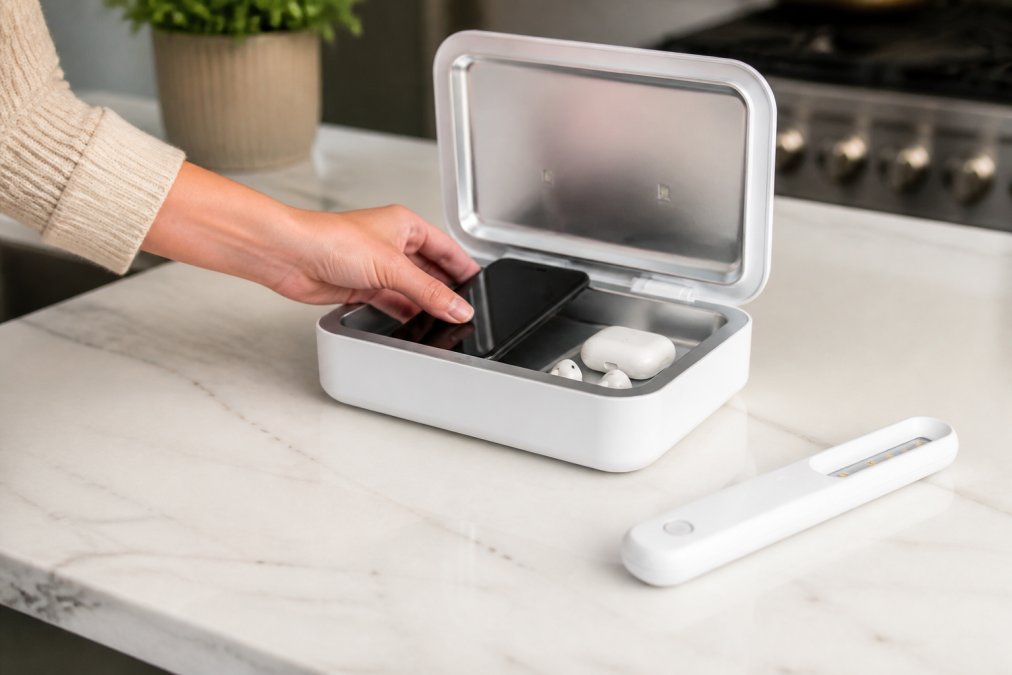
UV-C Boxes vs. UV Wands vs. Spray-Based Tools
UV-C boxes enclose the device and run a timed cycle. Best for phones, earbuds, watches, and small accessories. No skill required, no mess.
UV wands let you sweep light across larger or oddly shaped items like keyboards and game controllers. Coverage depends entirely on how carefully you move the wand.
Spray-based tools use a liquid disinfectant, often with a UV-C chamber as a secondary step. They handle crevices that light can't reach, but require drying time and can leave residue.
| Type | Best For | Cycle Time | Main Drawback |
|---|---|---|---|
| UV-C box | Phones, earbuds, watches | 3-10 min | Limited chamber size |
| UV wand | Keyboards, remotes, odd shapes | Manual | Uneven coverage |
| Spray-based | Crevices, fabric cases | Varies | Residue, drying time |
For most households, a UV-C box covers the daily essentials, and a wand handles everything else. CleanCharge carries lifestyle gadgets in this space, and you can browse the current selection to see what fits your routine. New customers can take 20% off with code First20.
Common Mistakes That Waste Your Sanitizing Gadget
The most common mistake is overloading the chamber. Stacking a phone on top of earbuds blocks light from reaching the bottom item, and you end up with a half-clean cycle.
Other frequent errors:
- Running a cycle on a device that still has visible grime on it
- Assuming one pass is enough for heavily soiled items
- Skipping the interior wipe-down, which lets debris build up
- Leaving items in the box after the cycle ends, which does nothing extra
- Trusting a "sanitized" indicator light without checking the seal
A second mistake is expecting UV-C to replace basic cleaning. Light doesn't remove oil, dust, or sticky residue. Wipe first, then sanitize.
Conclusion
Getting the most from sanitizing gadgets comes down to matching the tool to the device and building a routine you'll actually keep. UV-C boxes handle the daily items, wands cover the awkward shapes, and sprays reach what light can't.
CleanCharge stocks lifestyle gadgets designed to make that routine simple, with competitive pricing and frequent sales. Browse the collection, apply code First20 for 20% off your first order, and find the setup that fits your devices.
Frequently Asked Questions
Do UV sanitizers actually kill germs on phones?
UV-C sanitizers use light in the 200-280 nanometer range, which damages the DNA and RNA of bacteria and viruses so they can't reproduce. Lab studies show strong reductions on non-porous surfaces like glass and metal when the device is exposed long enough. The catch is shadowing: cracks, case edges, and port openings block light. A UV-C box works best on a bare phone, and wiping dust off first helps the light reach the surface.
Is it safe to use UV-C light on electronic screens?
Short UV-C cycles are generally safe for glass screens, but the oleophobic coating that repels fingerprints can degrade with repeated exposure. Keep cycles short, avoid holding a wand directly against the screen for long stretches, and check the manufacturer's guidance for your specific device. If your screen already looks smudged or feels rough, the coating may be wearing down, and a microfiber wipe is the safer daily habit.
How long should you leave a phone in a UV sanitizer?
Most UV-C boxes run cycles between 5 and 15 minutes, and that range is designed to deliver the dose needed for common surface germs. Follow the cycle time your device specifies rather than guessing. Longer isn't automatically better because extended UV-C exposure adds wear without much added benefit once the surface is already treated. For best practices for sanitizing personal devices, run one full cycle and let the box finish.
Are UV sanitizing boxes worth the investment?
They earn their keep if you sanitize daily items like a phone, earbuds, keys, or a watch. A box handles several small items at once with no liquid and no residue, which matters for electronics. If you only think about germs once a month, a microfiber cloth and occasional alcohol wipe cover most needs. For heavy daily use, a box saves time and reduces how often you reach for wet wipes near ports.